
 Whether you are preparing for a career in academia, industry, government, or the nonprofit world, UCM GradPRO is here to support your journey. Explore tools to find the next steps that fit your goals
Where do you begin?
Right here. Whether you are just starting your graduate program or preparing to launch your career, here is your guide for exploring options, building skills, and making informed choices for your future.
1. Reflect on Your Goals
Graduate school is a great time to explore your interests and strengths—both academic and beyond. Ask yourself:
-
What excites me most about my work?
-
Do I want to stay in academia, or explore other options?
-
What are my skills, and how do they translate to different fields?
Use a self-assessment tool like ImaginePhD (for humanities/social sciences) or MyIDP and ChemIDP (for STEM).
2: Build Your Skills & Experience
Professional development happens in and outside the research space.
-
Attend workshops on communication, leadership, teaching, and job search prep.
-
Seek internships or short-term projects (on or off campus).
-
Practice translating your research for non-specialist audiences.
Don’t underestimate your transferable skills. Critical thinking, project management, and writing all go a long way in many fields.
3: Make a Plan
Create a flexible, personalized roadmap that evolves with you. Make sure you include:
-
Key experiences to pursue (e.g., internships, teaching)
-
Milestones like completing your CV or LinkedIn profile
-
Target dates for applying to jobs or fellowships
Check out our timelines for academic and industry careers.
Academic/Research Careers
The academic job search is a structured, multi-stage process, and while expectations vary by discipline and institution type, most pathways share a common set of milestones and materials. The most important first step is to learn what “strong” looks like in your specific field—typical timelines, what counts as independence, how publications are evaluated, and which experiences (teaching, mentoring, grants, collaborations) matter most for the roles you’re targeting. Start by speaking with your advisor and committee members, then broaden your perspective through conversations with recent alumni, postdocs, and faculty across different institution types (R1, teaching-focused, and national labs). With a clear understanding of norms and fit, you can build an application plan that is both realistic and competitive—and avoid last-minute scrambling when positions and fellowships open.
From there, it helps to choose a primary direction early enough that you can build the right evidence—and the right application packet—over time. While many skills overlap across academic and research careers, the emphasis differs substantially depending on the pathway you pursue. To make planning easier, we’ve organized guidance into three common tracks. Each track includes a suggested timeline of milestones, recommended experiences, and key materials to prepare so you can align your activities with the expectations of the roles you plan to apply for:
Postdoc → R1 Research Faculty
A postdoctoral position is a mentored, research-intensive step after the PhD that helps you deepen expertise, expand your publication and collaboration record, and demonstrate growing independence as you transition toward long-term roles such as faculty, staff scientist, or national lab researcher.
If this is you chosen career path, here is a timeline to help you prepare.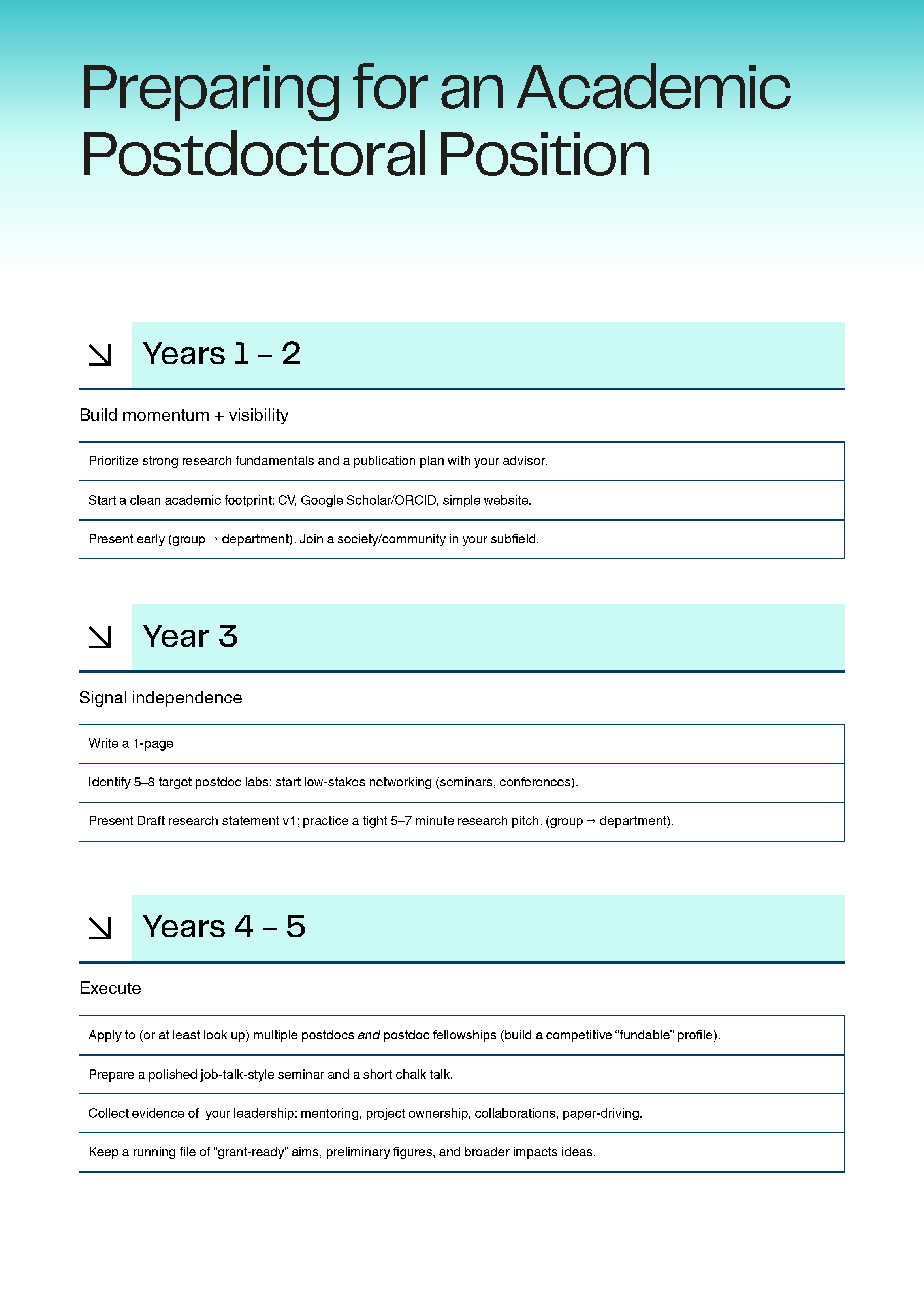
-
Faculty —especially your committee members—can be your best conduit to postdoctoral opportunities. They often know who is hiring, which groups are growing, and where strong matches exist, and they can make introductions that move your inquiry from “cold email” to a real conversation. It’s also worth knowing that many postdoc roles never appear as formal postings: a PI may have flexibility on a grant and can bring someone on when there’s a clear fit and a timely research need. Because of that, don’t limit yourself to listings.
Teaching-Focused Faculty:
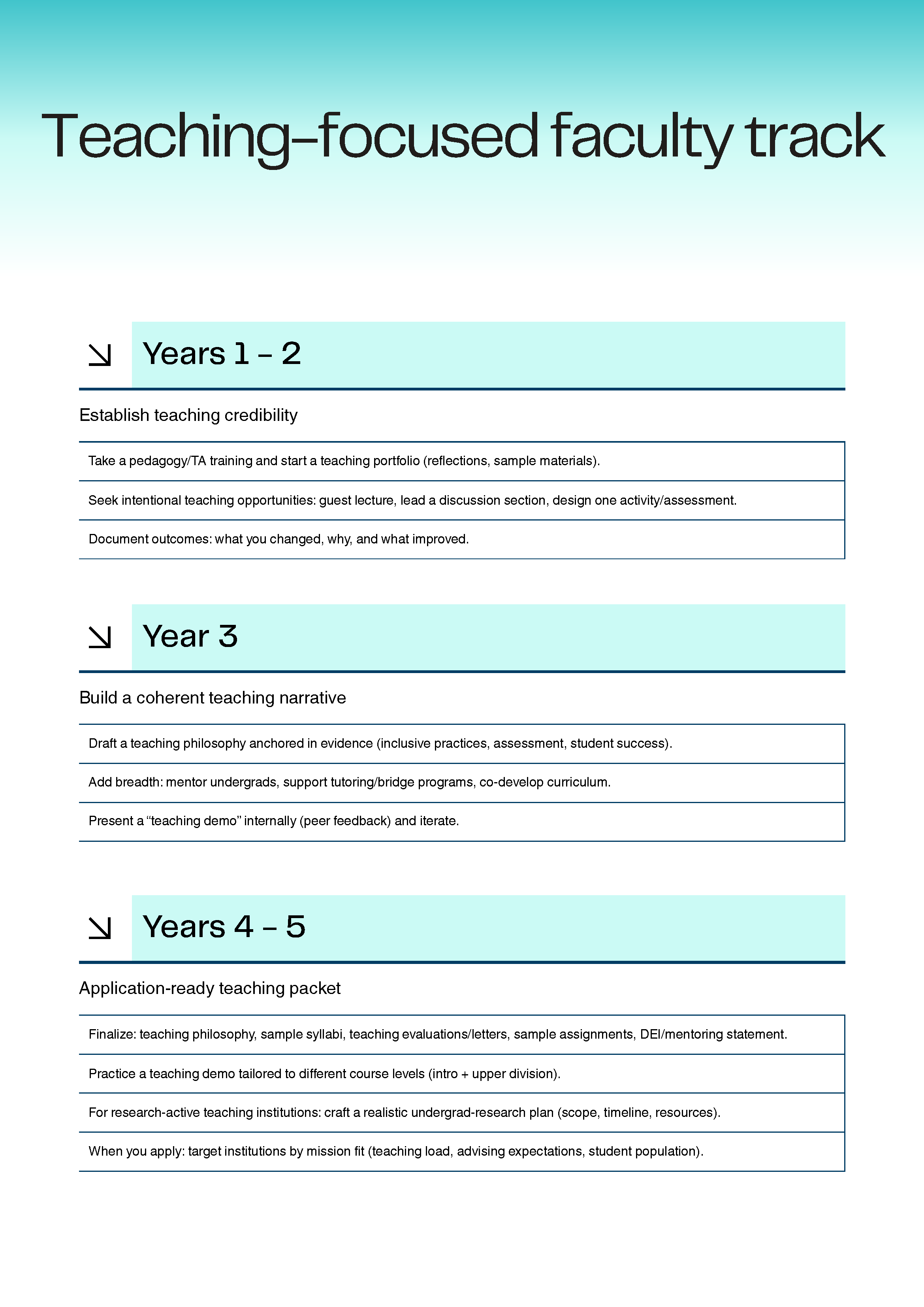 Teaching-focused academic positions center on student learning and academic mentorship, with success defined less by the volume of publications and more by instructional effectiveness, inclusive pedagogy, and meaningful contributions to curriculum and advising. These roles span community colleges, primarily undergraduate institutions, and teaching professor/lecturer lines at research universities, and they often value evidence that you can design engaging courses, assess learning thoughtfully, support diverse learners, and help students persist and thrive. A strong candidate typically brings a coherent teaching philosophy, a well-documented teaching portfolio (sample syllabi, assignments, evaluations, reflections), and a track record of mentoring—while maintaining a scholarship or professional engagement plan that fits the institution’s mission and workload.
Here is a timeline for this path.
Here are places to find teaching-focused academic jobs (lecturer/teaching professor, instructor, professor of practice, community college faculty, adjunct pools), plus a couple that are especially good for two-year colleges.
National Labs/Staff Scientist:
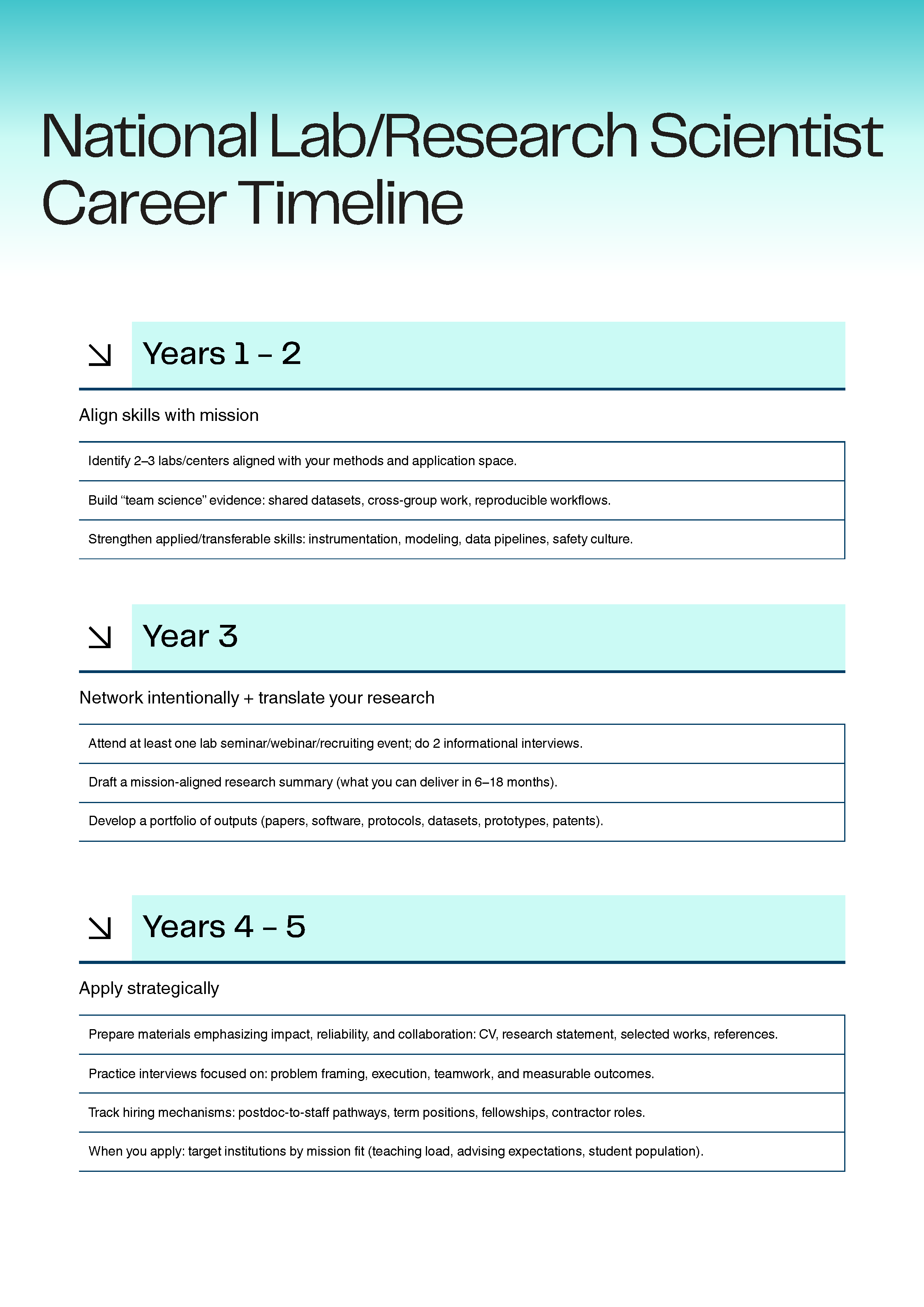 National lab careers offer a mission-driven alternative to the traditional faculty path, with roles that emphasize high-impact research delivered in teams—often at larger scale, with specialized facilities, and with clearer near-term deliverables tied to national priorities. Positions range from postdoctoral appointments to staff scientist and research scientist roles, and they typically reward deep technical expertise, strong publication or project outputs, and the ability to translate research into reliable results for complex programs. If you’re energized by collaborative R&D, large instrumentation platforms, and problem statements defined by real-world constraints, U.S. Department of Energy-affiliated labs and similar national research institutes can be an excellent fit.
Here is a timeline to help prepare for applying to National Labs.
And the link where all the job listings are available.
Did you know? More than 50% of PhD holders in the U.S. pursue careers outside of academia (NSF Survey of Doctorate Recipients, Council of Graduate Schools).
But if you are interested in a career in industry after graduation, or are even considering it as an option, let us help you explore your options and take confident steps toward your future in a timely manner.
Year 1: Early Self-Development, Career Exploration & Peer Support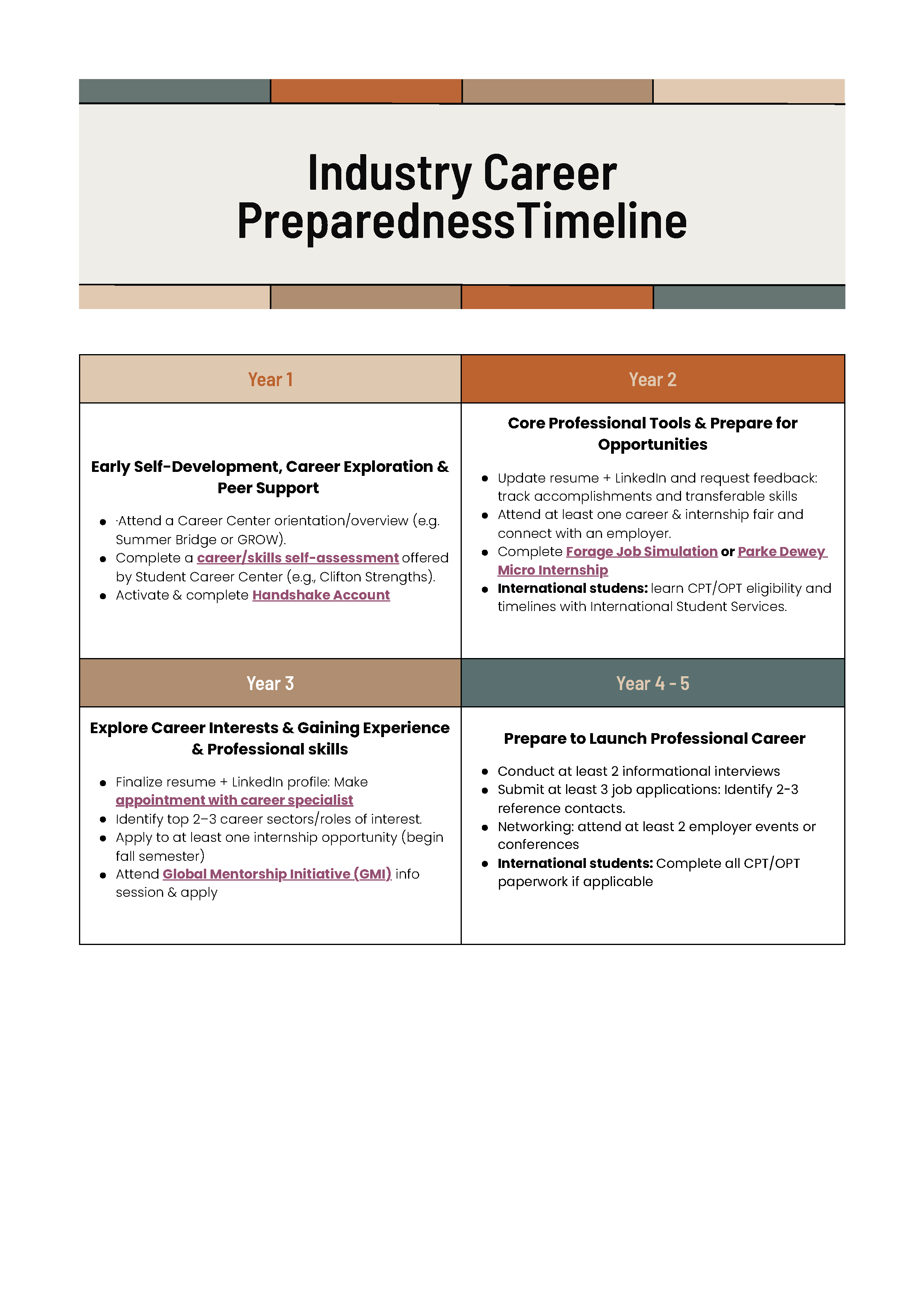
-
Attend a Career Center orientation/overview (e.g. Summer Bridge or GROW).
-
Complete a career/skills self-assessment offered by Student Career Center (e.g., Clifton Strengths).
-
Activate & complete Handshake Account
-
Join us for an Industry vs. Academia career pathways overview session.
Year 2: Core Professional Tools & Prepare for Opportunities
-
Update resume + LinkedIn and request feedback: track accomplishments and transferable skills
-
Attend at least one career & internship fair and connect with an employer.
-
Complete Forage Job Simulation or Parker Dewey Micro Internship
-
International students: learn CPT/OPT eligibility and timelines with International Student Services.
Year 3: Explore Career Interests & Gaining Experience & Professional skills
-
Finalize resume + LinkedIn profile: Make appointment with career specialist
-
Identify top 2–3 career sectors/roles of interest.
-
Apply to at least one internship opportunity (begin fall semester)
-
Attend Global Mentorship Initiative (GMI) info session & apply
Year 4 - 5: Prepare to Launch Professional Career
-
Conduct at least 2 informational interviews
-
Submit at least 3 job applications: Identify 2-3 reference contacts.
-
Networking: attend at least 2 employer events or conferences
-
International students: Complete all CPT/OPT paperwork if applicable


